How Soviet Venera spacecraft survived Venus's crushing heat and pressure to return the only photos ever taken on its surface.
May 16, 2026
•
9 min read
The Venera Missions: Soviet Conquest of Venus | Guide to Space
~2,400 words
12 min read
Updated May 2026
In This Guide
01A Twenty-Three-Year Campaign
02The Planet They Were Going To
03All Sixteen Missions
04Learning by Failing
05The First Landings
06Seeing the Surface
07Venera 13 and 14: The Peak
08Mapping from Orbit, Then Silence
09Legacy: What They Left Behind
10FAQ & Sources
01, Overview
The Venera Missions: Soviet Conquest of Venus
In 1961, when Soviet engineers set their sights on Venus, the scientific consensus held that the planet harbored oceans, jungles, perhaps even life. The first Venera probes were built for that world. What followed was twenty-three years of systematic demolition of that idea: each mission learning from the last, each probe rebuilt to survive conditions the previous one had not anticipated, and each one pushing further into a planet that seemed almost designed to kill anything humanity sent its way.
Between 1961 and 1984, the Soviet Union sent sixteen spacecraft to Venus. In the end, ten reached the atmosphere and only eight landed intact. In all, they produced the first in-situ measurements of another planet's air, the first soft landing on another world, the only photographs ever taken on Venus's surface, the first audio recording from another planet, and the first high-resolution radar map of a planet beyond Earth.1
Since March of 1982 no spacecraft has touched the surface of Venus. But the pictures and data the Veneras returned remain the only direct record we have of the planet's ground, a record that cost more than two decades of failures, redesigns, and a stubborn persistence to obtain.
16
Venera Missions Flown
8
Successful Surface Landings
127 min
Record Surface Survival
465 °C
Surface Temperature (900 °F)
~90x
Atmospheric Pressure vs Earth
1961–84
Program Duration
✦
02, The Target
The Planet They Were Going To
Venus and Earth are nearly the same size and mass and formed from the same material at roughly the same time in cosmic history. But from those identical starting points, the two planets ended up in radically different places.2
Venus's surface temperature averages 465 °C (900 °F), hotter than Mercury despite Venus being nearly twice as far from the Sun. The atmosphere is 96.5% carbon dioxide and traps heat so completely that the temperature barely varies between day and night. Surface pressure is about 90 times Earth's at sea level, roughly the pressure 900 meters beneath the ocean. The Venera engineers had to build something closer to a deep-sea submarine than a conventional spacecraft.
Property
Venus
Earth
Diameter
12,104 km (7,521 mi)
12,742 km (7,918 mi)
Surface Temp.
465 °C (900 °F)
15 °C (59 °F) avg.
Atmos. Pressure
92 bar (1,334 psi)
1 bar (14.7 psi)
Atmosphere
96.5% CO₂, 3.5% N₂
78% N₂, 21% O₂
However, none of this was known in 1961. The Venera engineers were not building for a hell planet. They were building for a world believed to host oceans and jungles, and the program's first decade would consist largely of reckoning with how badly wrong that starting assumption was.
✦
03 — All Sixteen Missions
All Sixteen Veneras at a Glance
1961
Venera 1
Launched Feb 12, 1961
First spacecraft launched toward another planet; contact lost before reaching Venus.
1965
Venera 2 & 3
Nov 12 & Nov 16, 1965
Venera 2: communications failed just before closest approach. Venera 3: first human-made object to impact another planet; contact lost before entry on both.
1967
Venera 4
Launched Jun 12, 1967
First in-situ measurement of another planet's atmosphere; identified Venus's air as predominantly CO₂.
1969
Venera 5 & 6
Jan 5 & Jan 10, 1969
Twin atmospheric probes. Both transmitted descent data before being crushed; together they refined the temperature and pressure gradient through the lower atmosphere.
1970
Venera 7
Launched Aug 17, 1970
First soft landing on another planet; transmitted from the surface for 23 minutes.
1972
Venera 8
Launched Mar 27, 1972
First measurement of surface light levels and direct soil composition analysis.
1975
Venera 9 & 10
Jun 8 & Jun 14, 1975
First photographs from the surface of another planet. Venera 9's orbiter became Venus's first artificial satellite. Venera 10 returned a second panorama ~2,200 km away, showing distinctly different terrain.
1978
Venera 11 & 12
Sep 9 & Sep 14, 1978
Both detected atmospheric electrical discharges during descent, suggesting lightning in the venusian clouds. On both landers, all camera lens caps failed to release, returning no images.
1981
Venera 13 & 14
Oct 30 & Nov 4, 1981
Venera 13: first color photos and first audio recordings from another planet's surface; survived 127 minutes. Venera 14: X-ray fluorescence identified the surface rock as tholeiitic basalt; survived 57 minutes.
1983
Venera 15 & 16
Jun 2 & Jun 7, 1983
Twin synthetic-aperture radar orbiters. Together they mapped roughly the northern quarter of Venus at 1.5 to 2.5 km resolution, revealing volcanic plains, tectonic ridges, and the circular features now called coronae.
04 — Early Missions
Learning by Failing: Venera 1 Through 6
The first three Veneras (1961 to 1966) all failed before returning useful data due to communications losses and entry failures before the spacecraft could measure anything. Soviet engineers studied these failures and retooled. And with Venera 4, launched in June 1967, they became the first to measure another planet's atmosphere directly with a spacecraft. As it descended on October 18, 1967, Venera 4's instruments identified the air as predominantly carbon dioxide with traces of nitrogen and almost no water vapor, and revealed that conditions deeper down were far harsher than anyone had estimated.3
That single descent confirmed what the program had been built to disprove. The probe was crushed before reaching the surface, but it had already shown that the original Venera design, built for around 10 atmospheres of pressure, was an order of magnitude too weak. Now the hardware had to catch up. Venera 5 and 6, twin atmospheric probes arriving in May 1969, refined the temperature and pressure gradient through the lower atmosphere and confirmed the scale of the problem: any future lander would need a hull more like a bathysphere than a spacecraft.
✦
05 — The First Landings
Venera 7 and 8: The First Footholds
The rebuild worked. Venera 7 reached Venus in December 1970 and became the first spacecraft to land softly on another planet, transmitting from the surface for 23 minutes before its signal faded. Its data gave humanity its first direct surface measurement: roughly 475 °C and around 90 atmospheres of pressure.4 The engineers had finally built something capable of surviving long enough to say something meaningful.
Venera 8 followed in July 1972 with a more capable lander. Among its readings was one that would shape the entire next phase of the program: surface light levels. Enough sunlight filtered through the thick cloud cover to make photography possible. That single measurement is what allowed the next generation of Veneras to carry cameras. The program was learning, not just surviving, and now it had something specific to aim for.
✦
06 — Surface Imagery
Seeing the Surface: Venera 9 Through 12
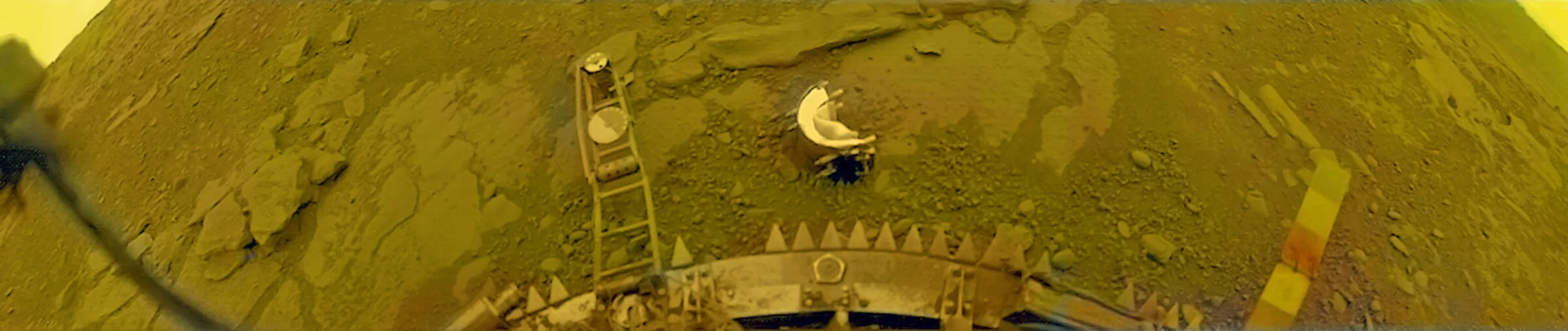
The view from the ground. Venera 13's rear camera captured this color panorama of the Venusian surface on March 1, 1982, the only color photographs ever taken on Venus's surface. Image: Russian Academy of Sciences / Ted Stryk
The Venera 9 and 10 landers arrived in October 1975 carrying scanning telephotometers, cameras built inside the pressure hull that swept the scene one line at a time through a small heat-resistant window. What they showed, nobody had quite expected. Venera 9 returned the first photographs ever taken from the surface of another planet on October 22, 1975. The images showed angular, freshly fractured boulders, some up to 60 cm across, on a surface that had not been smoothed by erosion, implying either recent geological activity or very slow weathering, and probably both.5
Venera 10 landed about 2,200 km from Venera 9 three days later and showed a different terrain: flatter, more weathered rock slabs. Two landing sites, two landscapes, and a planet more geologically varied than anyone had imagined.
Lens caps were a recurring problem. On Venera 9, 10, and 13, one of the two camera caps failed to release. On Venera 11 and 12, neither cap released, so two landers that survived more than an hour on the surface returned no images at all. Venera 14 ejected its cap directly under the soil-compressibility arm, which then dutifully measured the compressibility of the lens cap.
Venera 11 and 12 arrived in December 1978 and both detected atmospheric electrical discharges during descent, suggesting lightning in the venusian clouds. Their cameras returned nothing because of the lens-cap failures, but their atmospheric instruments worked, and the program pressed on. By now, Venera had a rhythm: arrive, survive as long as possible, measure whatever you can, die. Then build the next one better. It had been working for nearly two decades, and it was about to produce its finest result.
✦
07 — The Peak
Venera 13 and 14: Color, Sound, and Rock
Venera 13 landed on March 1, 1982, in a region east of Phoebe Regio. The parachute that had slowed it through the upper atmosphere was jettisoned at about 50 km altitude, and a ring-shaped air brake slowed the lander to roughly 7 to 8 m/s for touchdown. Inside the hermetically sealed hull, a lithium-nitrate thermal battery absorbed heat to keep the electronics alive. Surface conditions at the landing site read 457 °C and 89 atmospheres.6
The cameras began scanning within seconds. Each panorama was assembled line by line through dark-blue, green, and red filters, then relayed to Earth via the flyby bus overhead. Venera 13 returned the first color images and the first audio recordings ever taken from another planet's surface. The microphones picked up faint wind, near-surface air on Venus barely moves, and the mechanical clicks of the lander's own drill.
Venera 13 was designed to last 32 minutes on the surface. It lasted 127, nearly four times its intended operational life.
The drill was a small mechanical miracle: a spring-loaded arm bored into the rock, captured a sample, and retracted it into an analysis chamber cooled to 30 °C, where an X-ray fluorescence spectrometer measured its composition. The result placed the surface squarely in the basalt family, with elevated potassium pointing to alkaline volcanic rock.
Four days later, Venera 14 landed about 950 km southwest. It survived 57 minutes and confirmed a different basalt composition closer to tholeiitic, the kind of rock that makes up Earth's ocean floor. Its soil-compressibility sensor deployed onto a circular lens cap that had landed beneath it, and that reading had to be discarded. The geochemistry, though, was real. It remains the only direct rock-chemistry data ever taken from Venus's surface, and it was obtained by a spacecraft that had roughly one hour to live from the moment it touched the ground.
✦
08 — From Orbit, Then Silence
Venera 15 and 16, and the Long Gap That Followed
The program closed not with another lander but with two radar orbiters. Venera 15 and 16, arriving in October 1983, mapped roughly the northern quarter of Venus using synthetic-aperture radar at about 1.5 to 2.5 km resolution. They revealed broad volcanic plains, raised highlands, tectonic ridges, and the strange circular features now called coronae, places where plumes of hot mantle appear to have pushed up and then collapsed the crust above them.7
After Venera 16, Venus went quiet. ESA's Venus Express orbited from 2006 to 2014 and Japan's Akatsuki has been studying the atmosphere from orbit since 2015, but no spacecraft has landed on Venus in more than forty years. The reasons are partly money and partly physics: surface electronics still fail in minutes, and no one has clearly surpassed what the Soviets achieved with thermal mass alone.8
That may be about to change. NASA selected two Venus missions in 2021, DAVINCI, an atmospheric probe, and VERITAS, a radar orbiter, and Russia's proposed Venera-D would return both an orbiter and a lander to the surface. Forty years after the last Venera, the questions Venus raises about runaway greenhouse climates and the limits of habitability are more urgent than ever.9
✦
09 — Legacy
What the Veneras Left Behind
The Venera program succeeded precisely because the Soviet Union refused to treat early failure as the end. Every crushed probe and lost signal was fed back into the next design. The result was a body of knowledge that accumulated slowly, painfully, and completely, built not by a single brilliant mission but by two decades of iteration against one of the most hostile environments in the solar system.
What the Veneras left behind is not just data. They left the only images that exist of Venus's surface taken from the ground itself. They left audio recordings of an alien wind. They left direct chemical analyses of rocks on a world 261 million kilometers away. And they left an implicit challenge to anyone who came after: that planet is still there, the surface is still unvisited, and the instruments the Soviets landed in the 1970s and 1980s remain, in some respects, state of the art.
Venus is the planet we know least about among our nearest neighbors, and we know as much as we do entirely because of sixteen Soviet spacecraft, most of which never made it, and a small number that survived just long enough to change our understanding of where Earth might have been heading all along.
✦
10 — FAQ & Sources
Frequently Asked Questions
How long did Venera landers survive on the surface of Venus?
Survival times ranged from 23 minutes for Venera 7 to 127 minutes for Venera 13. Venus's surface temperature is roughly 465 °C (900 °F) and pressure is about 90 times Earth's at sea level. Venera 13 was designed to last 32 minutes but operated nearly four times that long.
Are the Venera photos the only images ever taken on Venus's surface?
Yes. As of 2026, the images returned by Venera 9, 10, 13, and 14 between 1975 and 1982 remain the only photographs ever taken from the surface of Venus. No spacecraft has landed there since Venera 14 in March 1982.
Why did the Soviet Union focus on Venus while NASA focused on Mars?
The Soviet Union had more powerful heavy-lift rockets in the early 1960s, allowing larger probes, and Venus is closer to Earth than Mars. American planetary scientists were drawn to Mars as a potentially life-bearing world. The result was an informal division: the Soviets owned Venus, and the Americans owned Mars.
✦
Sources
1 NASA Space Science Data Center. "Venera Program Overview." NASA NSSDC, 2023 ·
2 Williams, D.R. "Venus Fact Sheet." NASA NSSDC Planetary Fact Sheets, 2023 ·
3 Avduevskii, V.S. et al. "Measurements of Temperature and Pressure in the Atmosphere of Venus by the Venera 4 Probe." Journal of the Atmospheric Sciences, 25(4) (1968): 537–545 ·
4 Keldysh, M.V. "Venus Exploration with the Venera 4 through Venera 8 Spacecraft." Icarus, 30(4) (1977): 605–625 ·
5 Florensky, C.P. et al. "The Venera 9 and 10 Soviet Missions: Geomorphic and Geologic Findings." Geological Society of America Bulletin, 88(11) (1977): 1537–1545 ·
6 NASA NSSDC. "Venera 13 Descent Craft/Lander." Spacecraft ID 1981-106D ·
7 Barsukov, V.L. et al. "The Geology and Geomorphology of the Venus Surface as Revealed by the Radar Images Obtained by Veneras 15 and 16." Journal of Geophysical Research, 91(B4) (1986): D378–D398 ·
8 Svedhem, H. et al. "Venus as a More Earth-like Planet." Nature, 450 (2007): 629–632 ·
9 Garvin, J.B. et al. "Revealing the Mysteries of Venus: The DAVINCI Mission." The Planetary Science Journal, 3(5) (2022): 117 ·
10 Basilevsky, A.T. and Head, J.W. "The Surface of Venus." Reports on Progress in Physics, 66(10) (2003): 1699–1734.
Guide to Space, The Rise Daily
Part of an ongoing educational series on space science from therisedaily.com. Editorial content is original. All factual claims are sourced and footnoted above.