|
Guide to Space
Hubble Space Telescope: Complete Guide
01 — Overview
Hubble Space Telescope Overview
On April 25, 1990, Space Shuttle Discovery deployed a school-bus-sized telescope into low Earth orbit, and within weeks astronomers realized something was catastrophically wrong. A mirror ground to extraordinary precision had been ground to the wrong prescription, off by just 2.2 micrometers, a fraction of a human hair, and the most expensive scientific instrument ever launched was, for all practical purposes, myopic.1 Late-night hosts ran jokes for months. Congress held hearings. Then came December 1993.
In December 1993, a crew of seven astronauts spent eleven days installing corrective optics. When the new images came back, the scientists watching the first images come down fell silent. The telescope that Washington had written off was now the best eye humanity had ever pointed at the sky. What followed was three decades of science that permanently reshaped our picture of the cosmos: the age of the universe confirmed, dark energy discovered, two trillion galaxies counted.2
|
7.9 ft
Mirror Diameter (2.4 m)
|
340 mi
Orbital Altitude (547 km)
|
1.6M+
Observations Made
|
|
21,000+
Peer-Reviewed Papers
|
5
Servicing Missions
|
35+ yr
Years in Service
|
02 — Comparison
Hubble vs Ground-Based Telescopes: Why Space Changes Everything
Before Hubble launched, everyone asked: why go to space at all? We already had enormous mountaintop telescopes. The answer is Earth's atmosphere. Even on the clearest night, air turbulence limits ground-based resolution to roughly one arcsecond no matter how large the mirror. Hubble, above all that, resolves details twenty times finer. The atmosphere also blocks ultraviolet light entirely, wavelengths that carry critical information about stars and galaxies. Hubble has the eyes to see all of it.3
| Feature |
Best Ground-Based |
Hubble |
| Angular Resolution | ~1 arcsecond | 0.05 arcseconds (20x sharper) |
| Ultraviolet Access | Blocked by atmosphere | Full UV spectrum |
| Sky Background | Bright (airglow, pollution) | Pitch black — 50x darker |
| Faintest Objects | ~magnitude 24 | ~magnitude 31.5 |
| Wavelength Range | Optical only | UV through near-infrared |
03 — Engineering
How the Hubble Space Telescope Works: Mirror, Instruments, and Orbit
Hubble is a Cassegrain reflector. Light enters the tube, bounces off the primary mirror, reflects to a smaller secondary mirror, then passes through a central aperture leading to the scientific instruments behind it. The system holds its aim to within 0.007 arcseconds, equivalent to keeping a laser beam steady on a coin from 200 miles (322 km) away.4
Hubble's mirror was polished to 10 nanometers precision. That precision was the problem. The tool used to verify the mirror during polishing had a lens positioned 1.3 millimeters out of place, so every reading confirmed perfection, and the flaw wasn't found until Hubble was already in orbit transmitting blurry images back to Earth.1 The fix, Corrective Optics Space Telescope Axial Replacement (COSTAR) installed during Servicing Mission 1, placed small mirrors inside the telescope that counteracted the flaw with matching but opposite curvature.
The current instrument suite includes Wide Field Camera 3 (WFC3), the Cosmic Origins Spectrograph (COS), the Advanced Camera for Surveys (ACS), and the Space Telescope Imaging Spectrograph (STIS), collectively covering wavelengths from 115 to 2,500 nanometers. In 2024, a failing gyroscope prompted NASA to switch to one-gyro observing mode, limiting parts of the accessible sky but keeping the telescope scientifically productive.4 The images that come back are not photographs in any conventional sense. Each color represents a wavelength invisible to the human eye, translated so the structure and chemistry of the universe becomes legible.
| |
Hubble was designed to be serviced in orbit. That single design choice is the reason the telescope survived its mirror disaster and remained productive for 35 years.
|
04 — Science
Hubble's Greatest Discoveries: Dark Energy, Deep Field, and More
In 1998, two independent teams used Hubble to measure Type Ia supernovae across cosmic distances. Gravity was expected to be slowing the universe's expansion. However, the data showed the opposite: the expansion of the universe is speeding up. Something is pushing galaxies apart with increasing force. Scientists named it dark energy. Thirty-five years later, nobody knows what it is. It makes up roughly 68% of the total energy content of the universe, and the discovery earned the 2011 Nobel Prize in Physics.5
The Hubble Key Project measured Cepheid variable stars in distant galaxies to pin down the universe's expansion rate. Combined with cosmic microwave background data, this fixed the age of the universe at 13.8 billion years, narrowing a range that had previously spanned 10 to 20 billion years.6
| |
In January 1996, Hubble pointed at a blank patch of sky for 10 consecutive days. The resulting Hubble Deep Field revealed nearly 3,000 previously unknown galaxies. A later image, the Hubble Ultra Deep Field, captured over 10,000 galaxies, some seen as they appeared just 800 million years after the Big Bang. Combining these observations with statistical models placed the total galaxy count in the observable universe at roughly two trillion, ten times the previous estimate.2
|
Hubble's spectrographic capabilities also revealed that the mass of a galaxy's central black hole closely correlates with the mass of its stellar bulge, a relationship called the M-sigma relation. This was not predicted by any theory and implies that black holes and galaxies co-evolved across cosmic time. Before Hubble, supermassive black holes were theoretical. After it, they were facts.7
05 — Cosmology
The Hubble Tension: A Crack in the Standard Model of Cosmology
The Hubble Constant measures how fast the universe is expanding. Two independent methods give different answers. Measurements from the early universe, using the cosmic microwave background, give about 42 mi/s/Mpc (67 km/s/Mpc). Measurements from the local universe using Cepheid stars and supernovae, calibrated largely by Hubble, give about 45 mi/s/Mpc (73 km/s/Mpc). The gap is small in absolute terms. In physics, it's huge.8
JWST has since independently verified Hubble's Cepheid measurements and found the same result, ruling out calibration errors as the cause.9 If both measurements are correct, which multiple independent teams now believe, the standard cosmological model is missing something. New physics may be required: early dark energy, decaying dark matter, or a feature of the early universe not yet accounted for. Resolving the Hubble Tension is now a primary science goal of both JWST and the upcoming Nancy Grace Roman Space Telescope.
| |
Hubble was built to measure the universe's expansion rate. The number it helped establish is now pointing to a flaw in our deepest picture of reality.
|
06 — Hubble's Universe
Hubble's Universe: 35 Years of Images That Changed Astronomy
The Pillars of Creation has been reproduced more than any other astronomical photograph. The Hubble Deep Field, a ten-day exposure of a seemingly empty patch of sky, revealed nearly 3,000 previously unknown galaxies and changed how a generation thought about the scale of the universe. NASA and the Space Telescope Science Institute (STScI) maintain a free public gallery of hundreds of Hubble images at science.nasa.gov/gallery/hubbles-universe, spanning galaxies, nebulae, star clusters, planetary atmospheres, and the deepest views ever taken.
|
|
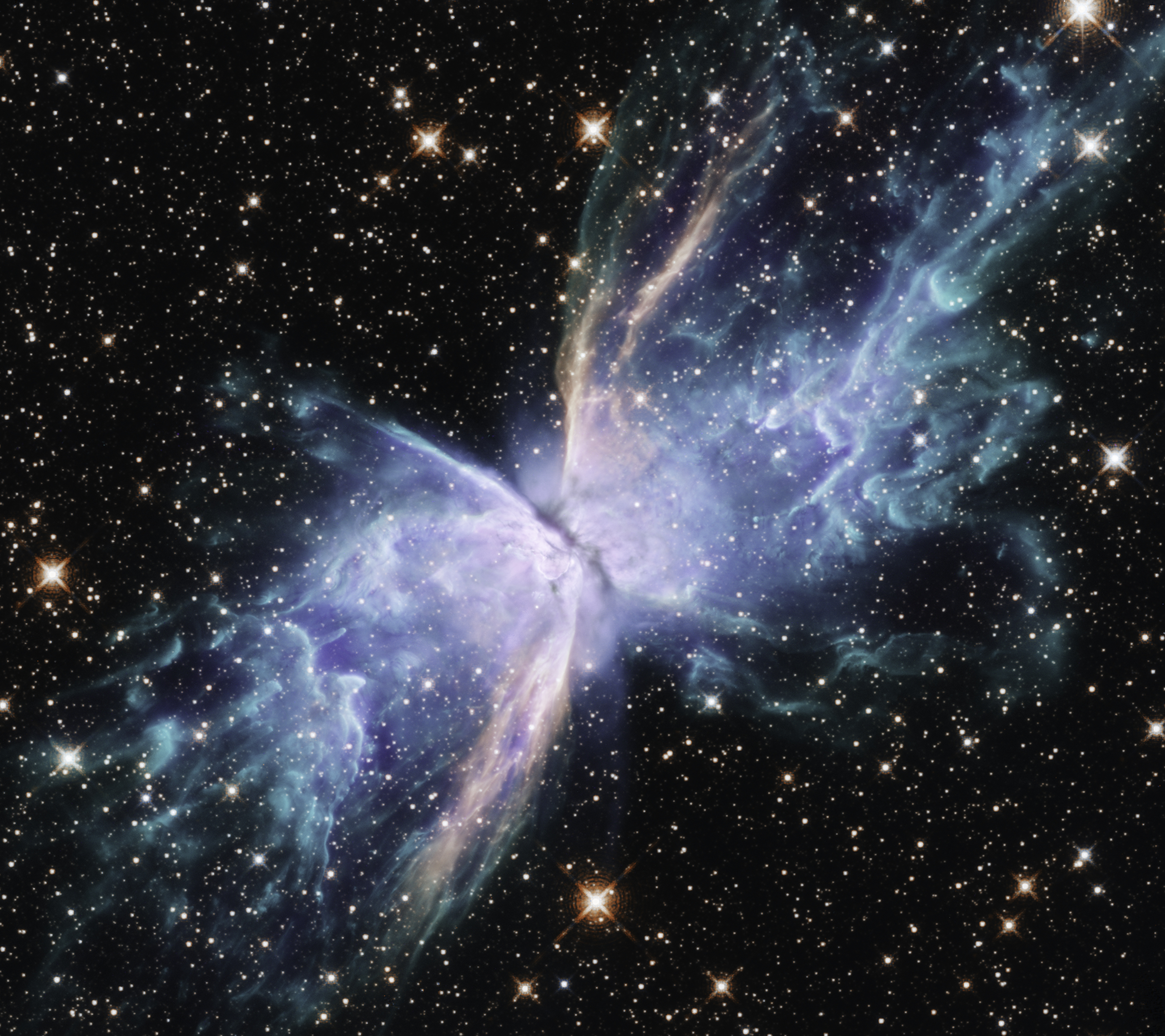
Hubble WFC3 · NGC 6302 — The Butterfly Nebula
The dying star at the center exceeds 400,000°F (222,000°C). Gas expelled at over 600,000 mph (965,000 km/h) forms the twin-lobed wings. WFC3, installed during the final servicing mission in 2009, revealed structure invisible to all previous instruments. Browse the full gallery at science.nasa.gov
|
07 — Servicing Missions
Hubble Servicing Missions: The Astronauts Who Saved a Telescope
Hubble was the first space observatory designed to be serviced in orbit. Five missions across 16 years sent 32 astronauts from three countries aboard four Space Shuttles to keep it alive.10
| Mission |
Date |
Key Work |
Spacewalks / Hours |
| Deployment — STS-31 | Apr 1990 | Hubble deployed; mirror flaw discovered within weeks | — |
| SM1 — STS-61 Endeavour | Dec 1993 | COSTAR corrective optics + WFPC2 installed; telescope transformed overnight | 5 / 35 hr |
| SM2 — STS-82 Discovery | Feb 1997 | STIS and NICMOS installed; wavelength range extended; insulation patched | 5 / 33 hr |
| SM3A — STS-103 Discovery | Dec 1999 | All 6 gyroscopes replaced after 4th failure; new computer 6x faster | 3 / 24 hr |
| SM3B — STS-109 Columbia | Mar 2002 | ACS installed (10x more powerful); new solar panels; NICMOS revived | 5 / 35 hr |
| SM4 — STS-125 Atlantis | May 2009 | WFC3 + COS installed; STIS and ACS repaired; gyros and batteries replaced | 5 / 37 hr |
| |
Five missions. Thirty-two astronauts. More than 191 hours of spacewalks. Every hour bought the telescope another decade of discovery.
|
The Columbia disaster in February 2003 initially led NASA to cancel SM4, as Hubble's orbit offered no safe-haven option at the International Space Station. After extensive safety review and sustained pressure from the scientific community, NASA reversed the decision and flew a final mission in 2009 with a rescue Shuttle on standby. Without that reversal, Hubble's aging instruments would have failed with no replacement.
Hubble is still operating. It is running on one gyroscope, its instruments decades old, its orbit slowly decaying with no way to boost it. And it is still doing science that no other telescope can replicate. Not the launch. Not the blurry mirror. Not even the Nobel Prize. The story is that a broken instrument, fixed by hand in orbit, became the most productive scientific machine in history, and we built nothing to replace it.
08 — FAQ
Frequently Asked Questions About the Hubble Space Telescope
|
How far away is the Hubble Space Telescope?
Hubble orbits Earth at roughly 340 miles (547 km), completing one orbit every 95 minutes at about 17,000 mph (27,300 km/h). It is close enough that Space Shuttle crews could visit for servicing, but no vehicle capable of reaching it has flown since the Shuttle retired in 2011. |
|
What has the Hubble Space Telescope discovered?
Hubble's most consequential discoveries include the first direct evidence for dark energy, the universe's age at 13.8 billion years, that nearly every large galaxy contains a supermassive black hole, and that the observable universe holds roughly two trillion galaxies. |
|
Does the James Webb Space Telescope replace Hubble?
No. JWST observes in infrared; Hubble observes in ultraviolet and visible light that JWST barely touches. Entire categories of science, including hot young stars and planetary atmospheres, require Hubble. Astronomers routinely use both telescopes together on the same targets. |
|
Will Hubble be serviced again?
Almost certainly not. No crewed vehicle capable of reaching Hubble's orbit exists since the Shuttle retired. NASA has adapted Hubble to one-gyro mode to extend its life, but no further hardware upgrades are planned. |
|
What is the Hubble Tension?
The Hubble Tension is a disagreement between two independent ways to measure the universe's expansion rate. Early-universe data gives about 67 km/s/Mpc; local measurements using Cepheid stars calibrated by Hubble give about 73 km/s/Mpc. The gap persists despite precision improvements and may point to new physics beyond the standard cosmological model. |
Hubble Space Telescope Sources and References
1 Lallo, M.D. "Experience with the Hubble Space Telescope: 20 years of an archetype." Optical Engineering, 51(1), 011011 (2012) ·
2 Conselice, C.J. et al. "The Evolution of Galaxy Number Density at z < 8." ApJ, 830(83), 2016 ·
3 NASA GSFC, "Hubble Space Telescope: General Information," NASA Science, 2024 ·
4 STScI, "Hubble's Instruments," HubbleSite, 2024 ·
5 Riess, A.G. et al. AJ 116:1009 (1998); Perlmutter, S. et al. ApJ 517:565 (1999) ·
6 Freedman, W.L. et al. "Final Results from the HST Key Project." ApJ 553:47 (2001) ·
7 Gebhardt, K. et al. ApJL 539:L13 (2000); Ferrarese & Merritt ApJL 539:L9 (2000) ·
8 Riess, A.G. et al. "A Comprehensive Measurement of the Local Value of H0." ApJL 934:L7 (2022) ·
9 Riess, A.G. et al. "JWST Observations Reject Unrecognized Crowding of Cepheid Photometry." ApJL 956:L18 (2023) ·
10 NASA, "Astronaut Missions to Hubble," NASA Science, 2024
|
Guide to Space — The Rise Daily
This article is part of an ongoing educational series on space science published by therisedaily.com. Editorial content is original. All factual claims are sourced and footnoted above.
© 2026 The Rise Daily. All rights reserved.
|
|


