

RISE
Your Personal Space Briefing
Hey there. Today marks the 40th anniversary of the Challenger disaster. We honor the seven heroes of STS-51-L who gave their lives in the pursuit of discovery. Forty years later, their courage remains a guiding light for every explorer reaching for the stars. We will never forget.
Here’s what’s orbiting in today’s issue:
- 🚀NASA Remembers Challenger Heroes
- 🌌Dark matter's cosmic influence
- 🛰️Europa ice shell measured
- ✨JWST crystal protostar found
- ⚫Rule-breaking black hole observed
📸 Image of the Day
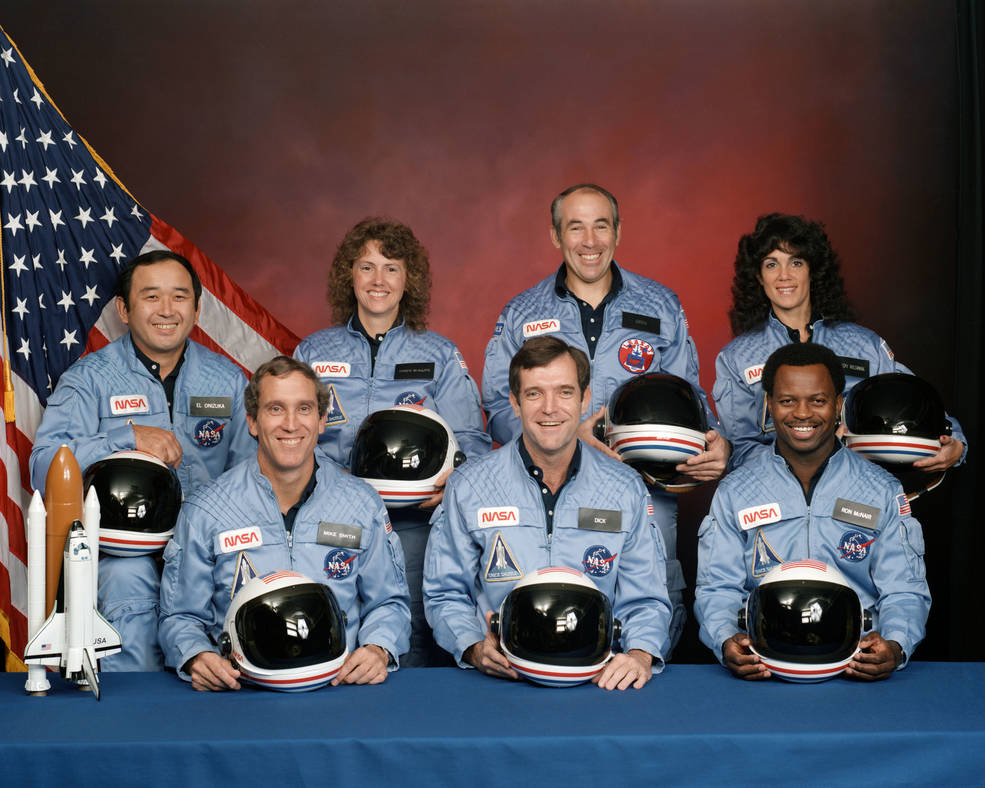
Left: STS-51L crew members Michael J. Smith, front row left, Francis R. “Dick” Scobee, Ronald E. McNair; Ellison S. Onizuka, back row left, S. Christa McAuliffe, Gregory B. Jarvis, and Judith A. Resnik.
🚀 Challenger Astronauts Honored 40 Years After Devastating Accident Read More
- NASA (National Aeronautics and Space Administration) officials and astronaut families gathered at Kennedy Space Center to commemorate the 40th anniversary of the tragic space shuttle Challenger accident, honoring the seven crew members.
- The shuttle ruptured 73 seconds after liftoff due to weakened O-ring seals in its right solid rocket booster, a catastrophic failure exacerbated by bitter cold temperatures on January 28, 1986.
- According to Kennedy's deputy director Kelvin Manning, these painful lessons require constant vigilance "now more than ever" with frequent launches and upcoming astronaut moonshots to prevent future tragedies from occurring.
🚀 Upcoming Launches
Starlink Group 17-19 | Falcon 9 Block 5 | 2026-01-29
10:17 EST | Vandenberg SFB, CA, USA
Bridging The Swarm (NeonSat-1A) | Electron | 2026-01-29
19:55 EST | Rocket Lab Launch Complex 1, Mahia Peninsula, New Zealand
Starlink Group 6-101 | Falcon 9 Block 5 | 2026-01-29
23:00 EST | Cape Canaveral SFS, FL, USA
🌌 New Map Reveals Dark Matter's Influence on Universe Formation Read More
- Durham University astronomers, with NASA’s Jet Propulsion Laboratory, created a high-resolution map of dark matter’s influence on cosmic formation using data from the James Webb Space Telescope (JWST).
- The team observed a sky section 2.5 times larger than the full Moon for 255 hours, identifying nearly 800,000 galaxies and confirming dark matter's strong gravitational pull on normal matter.
- This map provides new details on how dark matter’s gravity pulled ordinary matter together, leading to the formation of galaxies like our Milky Way and planets like Earth, according to the researchers.
🛰️ NASA's Juno Measures Europa's Ice Shell Thickness Read More
- NASA scientists analyzed data from the Juno spacecraft's 2022 flyby of Jupiter's moon Europa, providing new insights into its subsurface structure and potential for hosting a habitable environment.
- Juno's Microwave Radiometer (MWR) instrument determined Europa's ice shell averages about 18 miles (29 kilometers) thick, discriminating between previous models that ranged from under a mile to tens of miles.
- A thick shell implies a longer path for nutrients to travel from the surface to the ocean, a key consideration for NASA's upcoming Europa Clipper mission, according to investigator Scott Bolton.
📅 Today in Space History:
On January 28, 1986, the Space Shuttle Challenger exploded 73 seconds after launch, a moment forever etched in global memory. We honor the seven souls lost: Francis Scobee, Michael Smith, Judith Resnik, Ellison Onizuka, Ronald McNair, Gregory Jarvis, and Christa McAuliffe.
The disaster, rooted in the failure of a primary O-ring seal in the right solid rocket booster, fundamentally altered the trajectory of space exploration. As we mark the anniversary, we remember not just a mechanical failure, but a human sacrifice that sparked rigorous safety reforms and a renewed, somber commitment to the sanctity of every mission.
✨ James Webb Telescope Finds Crystal-Spewing Protostar Read More
- Astronomers using NASA’s James Webb Space Telescope (JWST) captured images of the protostar EC 53, finding evidence that explains the surprising presence of crystals in our outer solar system.
- JWST's NIRCam (Near-Infrared Camera) revealed that crystalline silicates are forged in the hot, inner disk of the young star and then carried to its outer edges by a strong outflow.
- This discovery provides the first conclusive evidence linking the intense heat needed to form crystals with a mechanism capable of transporting them to cold outer regions, solving a long-standing cometary puzzle.
⚫ Subaru Telescope Observes "Rule-Breaking" Supermassive Black Hole Read More
- An international team led by Waseda and Tohoku University scientists discovered an extraordinary quasar hosting a supermassive black hole with unusual properties, challenging current theoretical models of cosmic growth.
- Subaru Telescope's MOIRCS spectrograph measured the black hole's mass from its Mg II emission line, revealing an accretion rate reaching approximately 13 times the Eddington limit while still producing strong X-rays.
- The object's unexpected combination of features suggests it may be in a short-lived transitional stage, offering a rare observational window into time-variable black hole growth, according to lead author Sakiko Obuchi.
❓ Question of the Day
Which cosmic rule would you bend if you could?
Send us a reply with your answer!
As we close today’s look at the latest in orbit, we carry with us the reminders of why we explore. Space flight is a testament to human resilience and the high price of progress. Thanks for joining us as we navigate the complexities of the cosmos and honor those who paved the way.
Clear skies ahead,
- Zapp